Robot Finn — a coaching robot for the start of anxiety treatment
Graduation project for HvA's Lectoraat Digital Life. Robot Finn is a NAO robot designed to support people aged 16–30 with a social anxiety disorder in the hardest phase of treatment — the early weeks, when psychologists' homework exercises get skipped most often.
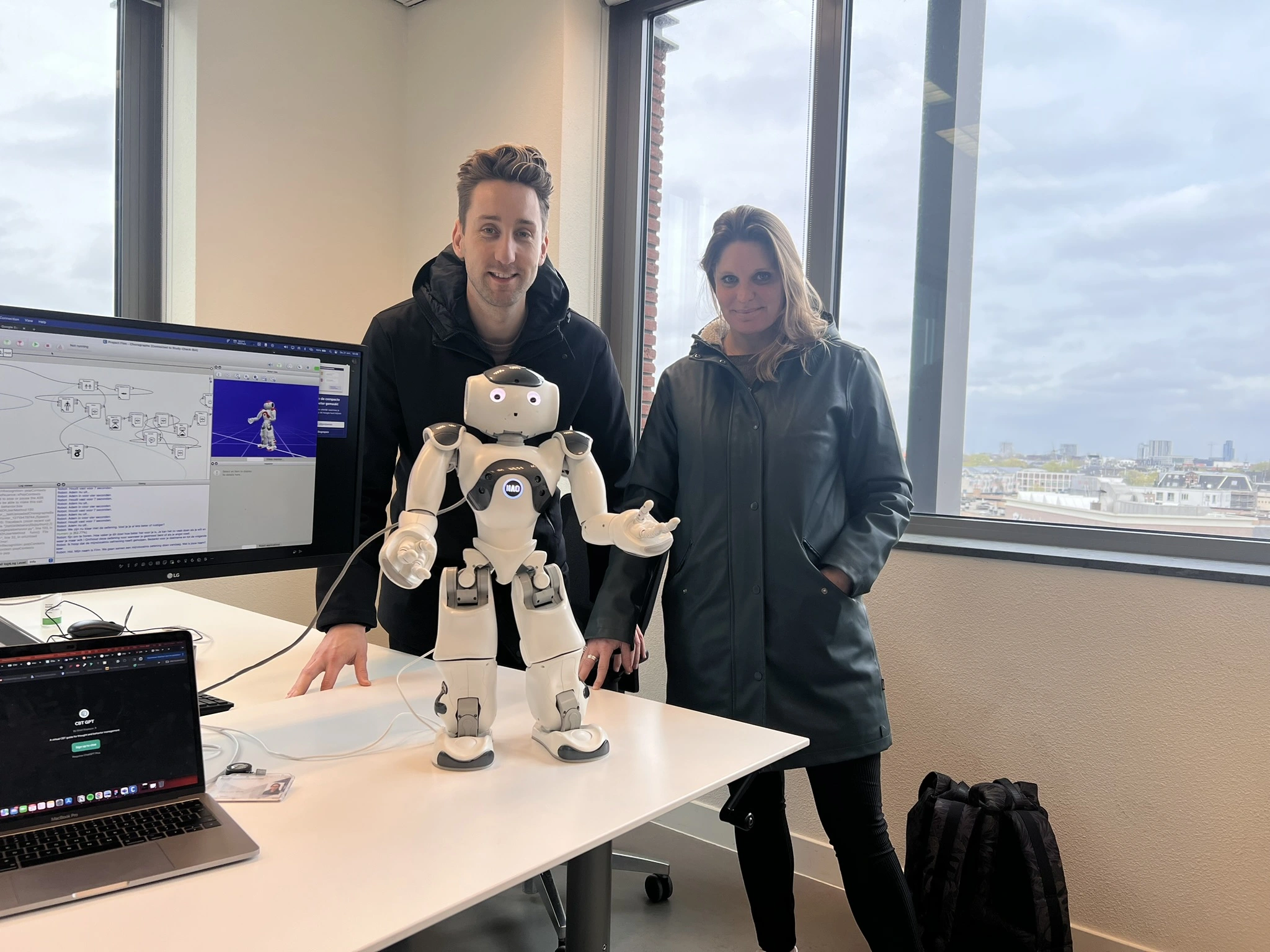
Therapy homework is where treatment quietly breaks down
In the Netherlands, 15% of adults experience an anxiety disorder at some point in their life (CBS). Waitlists for psychological care regularly stretch past 30 weeks due to staff shortages. But the sharper problem I found in expert interviews wasn't access to a psychologist — it was what happens between sessions.
Cognitive behavioral therapy relies on patients completing homework between sessions: thought records, breathing exercises, small exposure tasks. For people with social anxiety, that homework is often the first thing that gets avoided — which stalls the very treatment meant to help them.
Of adults in the Netherlands have or have had an anxiety disorder (CBS).
Waitlists for psychological care can run this long due to staff shortages.
In-depth interviews conducted with people currently in treatment for anxiety.
What actually happens in the treatment room
I ran desk research into anxiety disorders and treatment methods, interviewed two experienced psychologists, and spoke with 9 people currently receiving treatment for anxiety. Three patterns kept coming back: homework exercises often go undone, patients frequently feel low right after a session, and they don't always remember everything that was discussed — making the next session less productive than it should be.
Cognitive behavioral therapy is the most effective treatment for anxiety disorders (Dijkstra, 2012).
Expert interviews with practicing psychologists experienced in treating anxiety.
Robots already operating in Dutch healthcare settings, with adoption accelerating post-COVID.
Narrowing to who the robot could actually help
Anxiety disorders are broad — social anxiety, panic disorder, phobias, generalized anxiety, each with different underlying causes. I narrowed the target audience to 16–30 year-olds specifically in treatment for social anxiety, an age group navigating a major life transition (school, first jobs) and comparatively comfortable with new technology.
One more thing shaped the direction early: multiple interviewees said talking to a robot felt lower-stakes than opening up to a person directly — the robot "isn't really there to judge them," which made it easier to practice talking about the things that make them anxious.
From eight ideas to three directions
Using the Crazy 8 method, I sketched eight rapid concepts in eight minutes — from a walking meditation to a literal cuddle-robot. Three were developed into fuller concepts.
Picking the robot, then finding the right voice
CMD gave students access to three robots — the Alpha Mini, NAO, and Pepper. I built a comparison chart across usability, sensors, and cost, and started with the Alpha Mini for its size and expressive face. Feedback changed that: the Alpha Mini reads as a children's robot, and this project's audience is adults, so I switched to the NAO.
Voice and gesture mattered just as much as the software. Adjusting the robot's default voice pitch made it sound "too creepy," too fake, or too childish depending on the direction — the standard NAO voice tested best, landing as calm and clear. Movements had to be redesigned from scratch in Choregraphe's animation timeline so gestures felt reassuring rather than mechanical.
Even eye color became a deliberate decision, based on color psychology: a soft light blue while inhaling (calm, stillness), a deeper blue while holding the breath (cooling, grounding), returning to neutral white on the exhale.
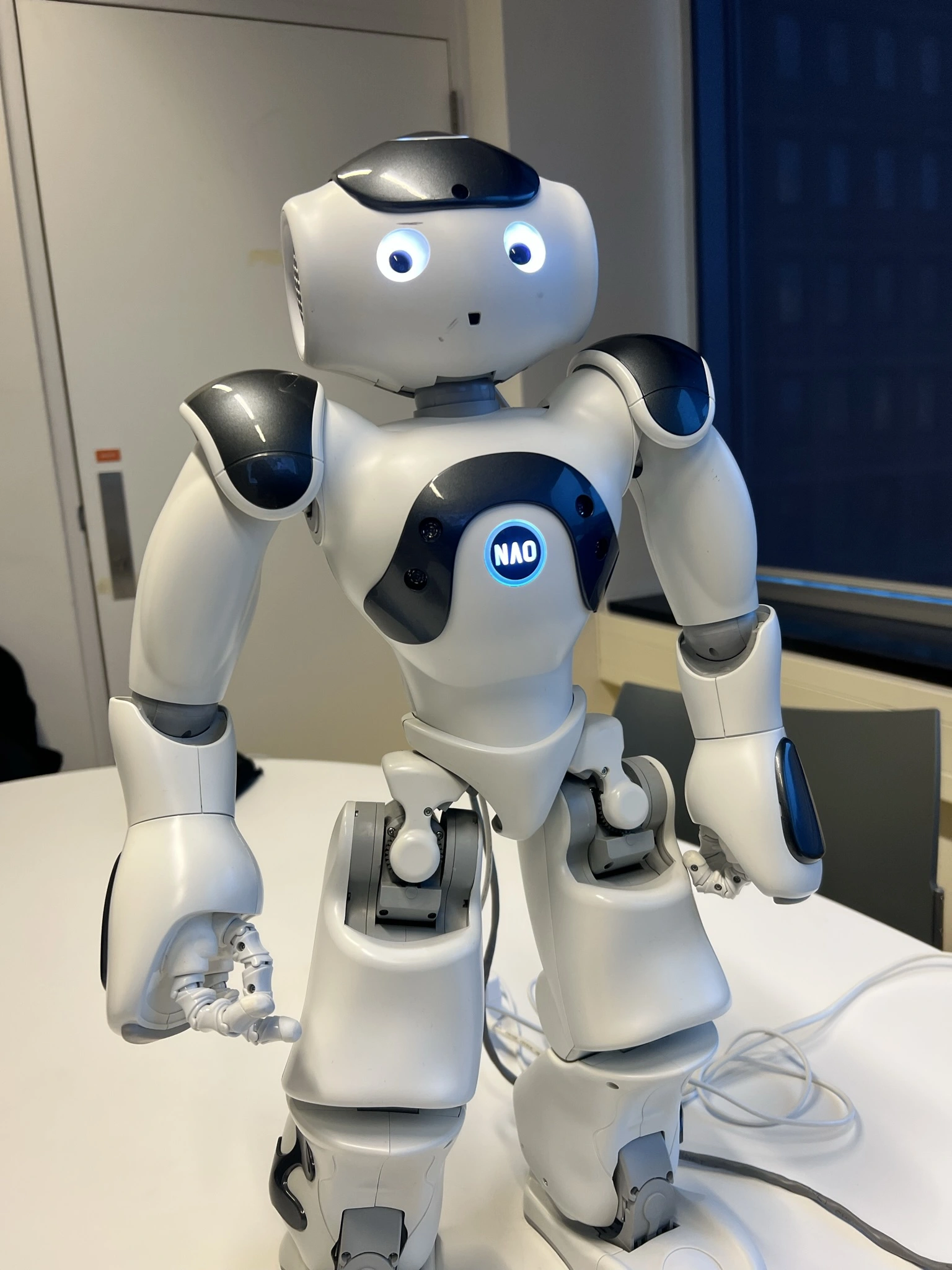
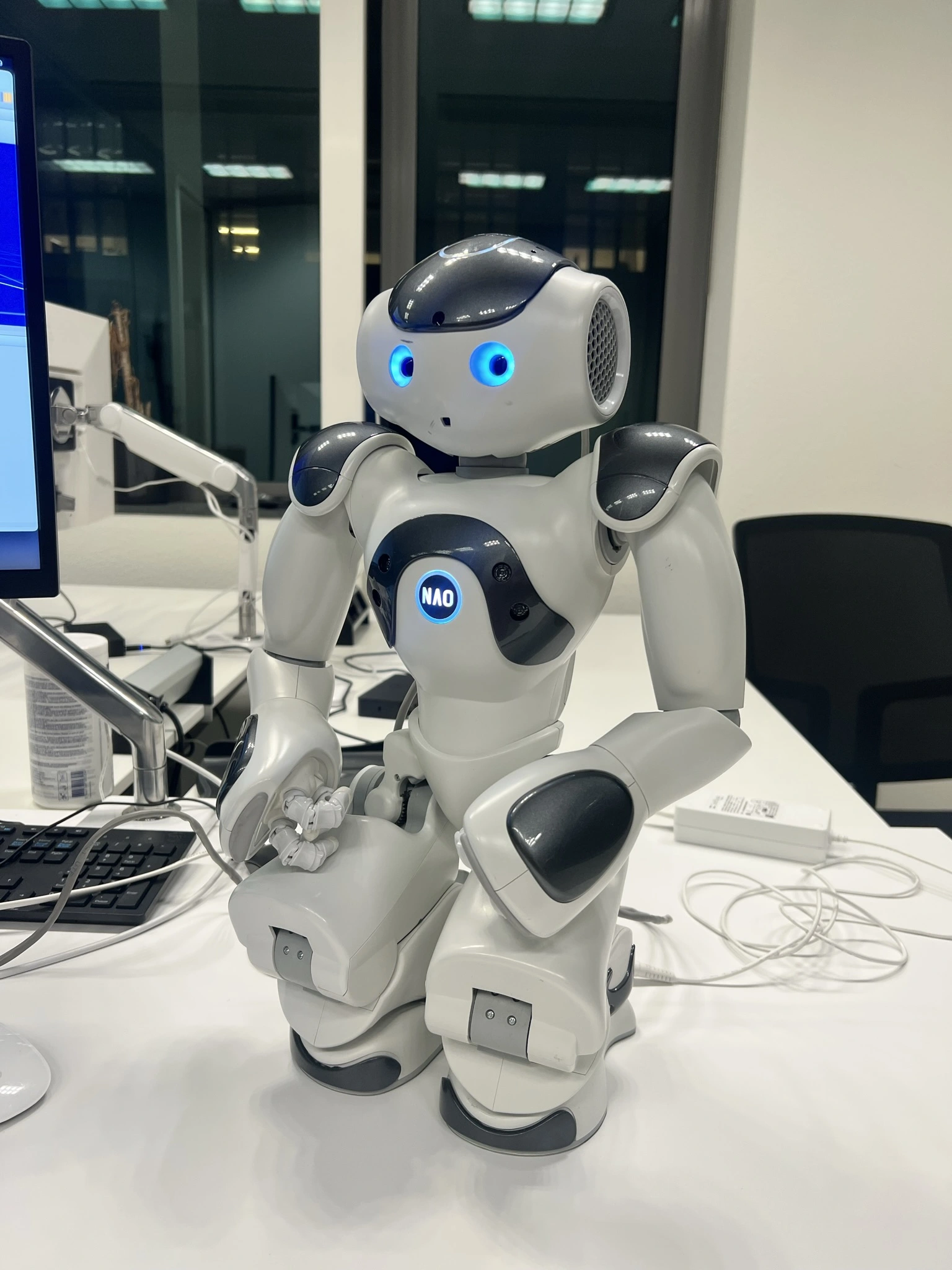
Four rounds of testing, each one narrowing the gap
The prototype went through four iterations, each tested with real people. Iteration 1 fixed a scripting bug where picking up background noise mid-sentence would send the robot into a dialogue loop — solved with stop-triggers and a tuned speech-recognition threshold. Iteration 2 reworked the robot's movements after early testers found them stiff and unnatural, following further research into gesture within mindfulness practice. Iteration 3 got the prototype running fully cable-free for the first time. Iteration 4 combined all three functionalities — meditation, the 5G exercise, and exposure therapy — into one working proof-of-concept.
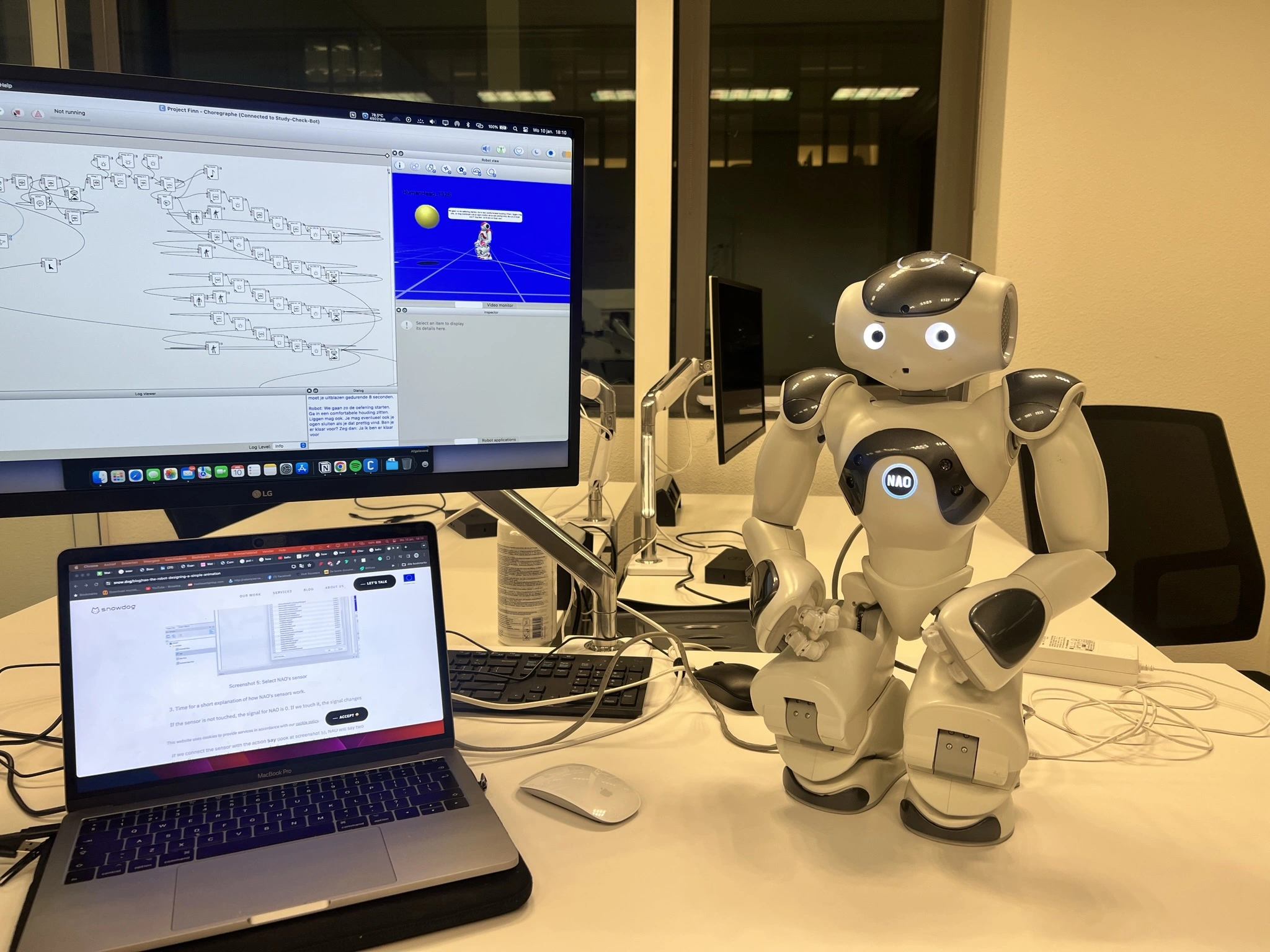
The final prototype
Robot Finn now runs three core functions: a guided breathing meditation based on the 4-7-8 technique, a CBT exercise using the 5G thought-record model, and a role-play exposure therapy scenario — each giving patients a lower-pressure way to practice what their psychologist would otherwise set as homework.
What I'd do differently
This is a proof-of-concept, not a clinical tool — the scripted dialogue trees mean conversations can feel rigid. I'd want to explore pairing the robot with a constrained AI model, scoped only to CBT-relevant responses, to make it feel more responsive without losing clinical safety.
I'd also want to build in a way for psychologists to review session summaries afterward, and to ask patients how anxious they're feeling before a session starts, so the robot could adjust exercise length accordingly. And as more than one person I interviewed pointed out: a robot like this should always be a supplement to treatment, never a replacement for the psychologist.